


Artificial intelligence is no longer just a futuristic technology used by large enterprises. Today, AI is becoming a practical business tool that helps mobile apps become smarter, faster, and more personalized. From AI chatbots and recommendation engines to voice assistants, fraud detection, predictive analytics, and automated workflows, AI-powered mobile apps are changing how businesses interact with customers.
For startups, enterprises, and growing companies, building an AI-powered mobile app can unlock better engagement, faster decisions, improved efficiency, and new revenue opportunities. But successful AI app development requires more than adding a chatbot or using a machine learning model. It needs the right strategy, clean data, scalable architecture, user-focused design, and continuous optimization.
In this guide, we will explain how to build an AI-powered mobile app, what features to include, how much it may cost, and what businesses should consider before starting development.
What Is an AI-Powered Mobile App?
An AI-powered mobile app is a mobile application that uses artificial intelligence, machine learning, natural language processing, computer vision, or predictive analytics to perform intelligent tasks. Unlike traditional apps that follow fixed rules, AI apps can learn from data, understand user behavior, automate decisions, and improve over time.
For example, an ecommerce app can recommend products based on user preferences. A fintech app can detect unusual transactions. A healthcare app can provide symptom-based guidance. A logistics app can predict delivery delays. A customer support app can answer user questions instantly through an AI chatbot.
The main goal of AI in mobile apps is simple: deliver smarter, more useful, and more personalized experiences.
Why Businesses Are Investing in AI Mobile App Development
AI mobile app development is becoming a strong priority because users expect apps to be fast, relevant, and easy to use. Businesses also want digital products that reduce manual work and provide useful insights.
AI helps companies improve customer experience, automate repetitive tasks, make better use of data, and create more competitive digital products. Instead of treating every user the same, an AI-powered mobile app can personalize content, offers, notifications, and recommendations based on individual behavior.
For businesses, this means higher engagement, better retention, improved operational efficiency, and stronger decision-making. For users, it means faster support, smarter suggestions, and a smoother app experience.
Also Read - Why Riyadh is Becoming the AI Innovation Hub of the Middle East
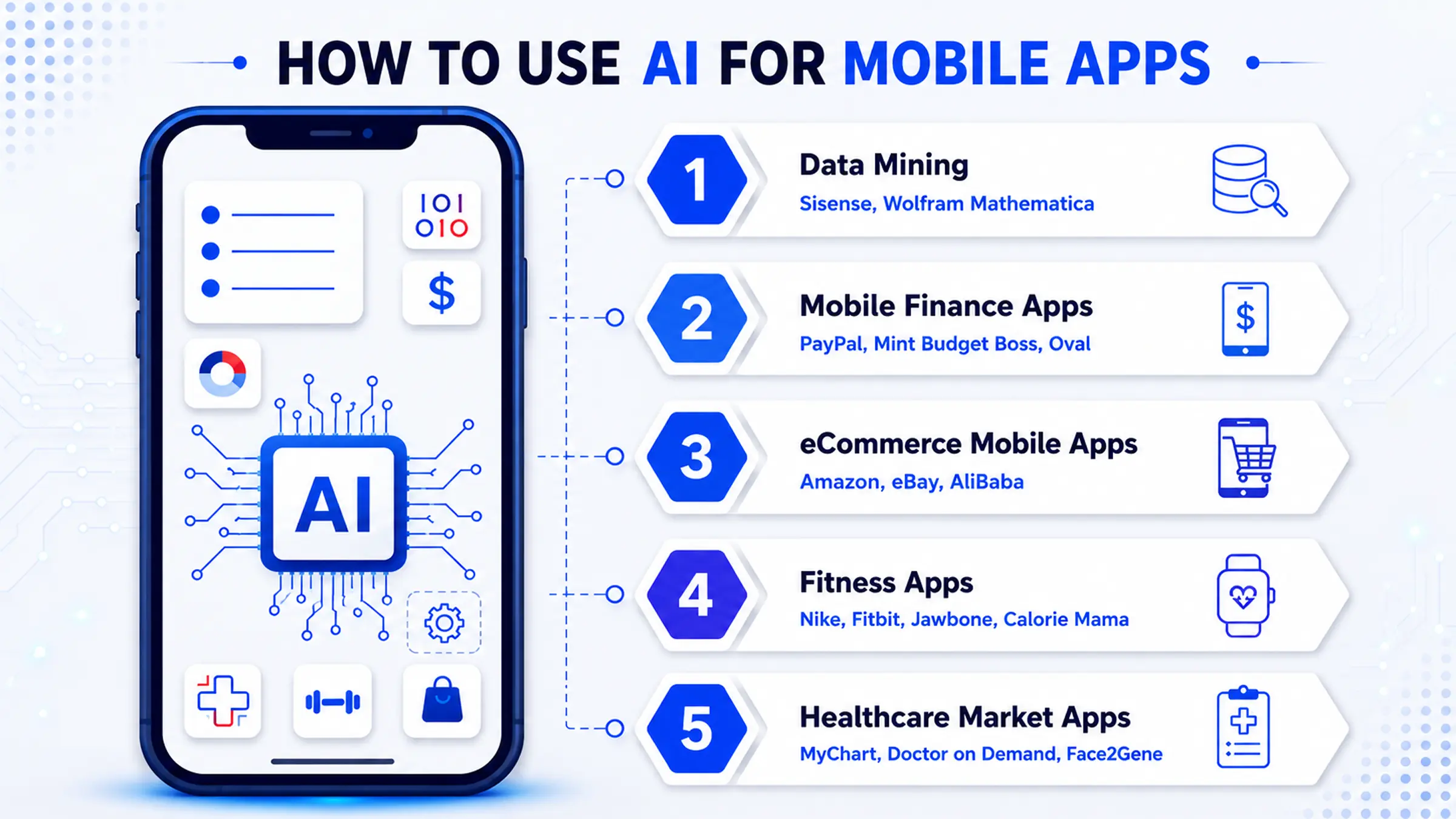
Step-by-Step Strategy to Build an AI-Powered Mobile App
1. Define the Business Problem First
The first step is not choosing the AI model. It is identifying the business problem you want to solve.
Many AI projects fail because companies start with technology instead of strategy. Before development begins, you should clearly define what the app needs to achieve. Do you want to improve customer support? Increase sales? Reduce fraud? Automate manual tasks? Improve user retention?
A strong AI mobile app strategy starts with one clear goal. For example, instead of saying "we want an AI app," say "we want to reduce customer support response time by 60% using an AI chatbot." This makes the project measurable and easier to execute.
2. Understand Your Target Users
AI works best when it is designed around real user needs. Before building the app, study your audience, their behavior, pain points, and expectations.
Ask questions such as:
- Who will use the app?
- What problems do they face?
- What tasks can AI make easier?
- What data will help personalize their experience?
- How much automation will users trust?
User research helps you decide which AI features are actually useful and which ones may create confusion. The best AI-powered mobile apps feel natural, helpful, and easy to use.
3. Choose the Right AI Features
Not every app needs advanced AI. The right features depend on your business model, industry, data, and user expectations.
Some popular AI mobile app features include:
- AI chatbot for customer support
- Personalized recommendations
- Voice search and voice commands
- Image and object recognition
- Predictive analytics
- Smart notifications
- Fraud detection
- Sentiment analysis
- AI-based search
- Automated document processing
- Real-time language translation
- AI-powered virtual assistant
For e-commerce, recommendations and smart search may be most important. For fintech, fraud detection and risk analysis may matter more. For healthcare, AI-based guidance, reminders, and data insights may add the most value.
4. Prepare and Organize Your Data
Data is the foundation of every AI-powered app. If the data is incomplete, outdated, biased, or poorly structured, the AI output will also be weak.
Your development team must collect, clean, label, and organize data before training or integrating AI models. This may include user behavior data, transaction history, product data, images, documents, location data, support conversations, or business records.
Data privacy is also critical. Businesses must handle user data securely and follow relevant compliance requirements. A good AI app development company will help you build secure data pipelines and protect sensitive information.
5. Select the Right Technology Stack
The technology stack depends on the app's complexity and AI requirements. A basic AI-powered mobile app may use third-party AI APIs, while a complex enterprise app may need custom machine learning models and cloud infrastructure.
Common technologies used in AI mobile app development include:
- Programming languages: Python, JavaScript, Swift, Kotlin
- Mobile frameworks: Flutter, React Native, native iOS, native Android
- AI/ML frameworks: TensorFlow, PyTorch, Scikit-learn
- NLP tools: OpenAI models, spaCy, Hugging Face Transformers
- Computer vision tools: OpenCV, TensorFlow Lite, ML Kit
- Cloud platforms: AWS, Google Cloud, Microsoft Azure
- Databases: PostgreSQL, MongoDB, Firebase
- Backend: Node.js, Python, FastAPI, Django
The right stack should support scalability, security, speed, and future improvements.
6. Decide Between Custom AI Model and Third-Party AI API
One major decision in AI app development is whether to build a custom AI model or use existing AI APIs.
Third-party AI APIs are faster and more affordable for many use cases. They are useful for chatbots, language processing, translation, speech recognition, and image analysis.
Custom AI models are better when your business has unique data, industry-specific workflows, or advanced requirements. For example, a healthcare diagnosis support tool or financial risk engine may need a custom model trained on specific datasets.
Many successful apps use a hybrid approach: third-party AI services for common tasks and custom models for business-specific intelligence.
7. Design a Simple and Trustworthy User Experience
AI should make the app easier, not more complicated. Users do not need to understand the technical model behind the app. They need clear results, simple actions, and confidence in the output.
For example, if an AI app recommends a product, explain why it is relevant. If an AI finance app flags a transaction, show the reason. If an AI healthcare app gives a suggestion, add disclaimers and encourage professional consultation where needed.
A good UX should include transparency, clear navigation, fast response time, and human support options when required.
8. Develop, Train, and Integrate the AI System
Once the strategy, data, features, and design are ready, the development process begins.
The team builds the mobile frontend, backend system, database, APIs, AI model or AI service integration, admin panel, and analytics dashboard. If a custom model is required, it must be trained, validated, tested, and optimized.
AI integration should be carefully connected with real app workflows. A model that only works in testing but does not connect with business systems will not create real value.
9. Test the AI-Powered Mobile App
Testing an AI app is different from testing a regular mobile app. You need to test app performance, security, usability, model accuracy, response time, edge cases, and data behavior.
Also Read - Why Fintech Companies Rely on Custom Software Development Services for Growth
Important testing areas include:
- Functional testing
- Performance testing
- AI model accuracy testing
- Security testing
- Bias testing
- Usability testing
- API testing
- Device compatibility testing
The app should be tested with real-world scenarios because AI systems often behave differently when exposed to live user data.
10. Launch, Monitor, and Improve Continuously
AI app development does not end after launch. AI models need monitoring, updates, and optimization. User behavior changes, data patterns shift, and app performance needs regular improvement.
After launch, businesses should track user engagement, retention, model accuracy, conversion rates, response time, and customer feedback. Continuous improvement helps the app stay reliable, useful, and competitive.
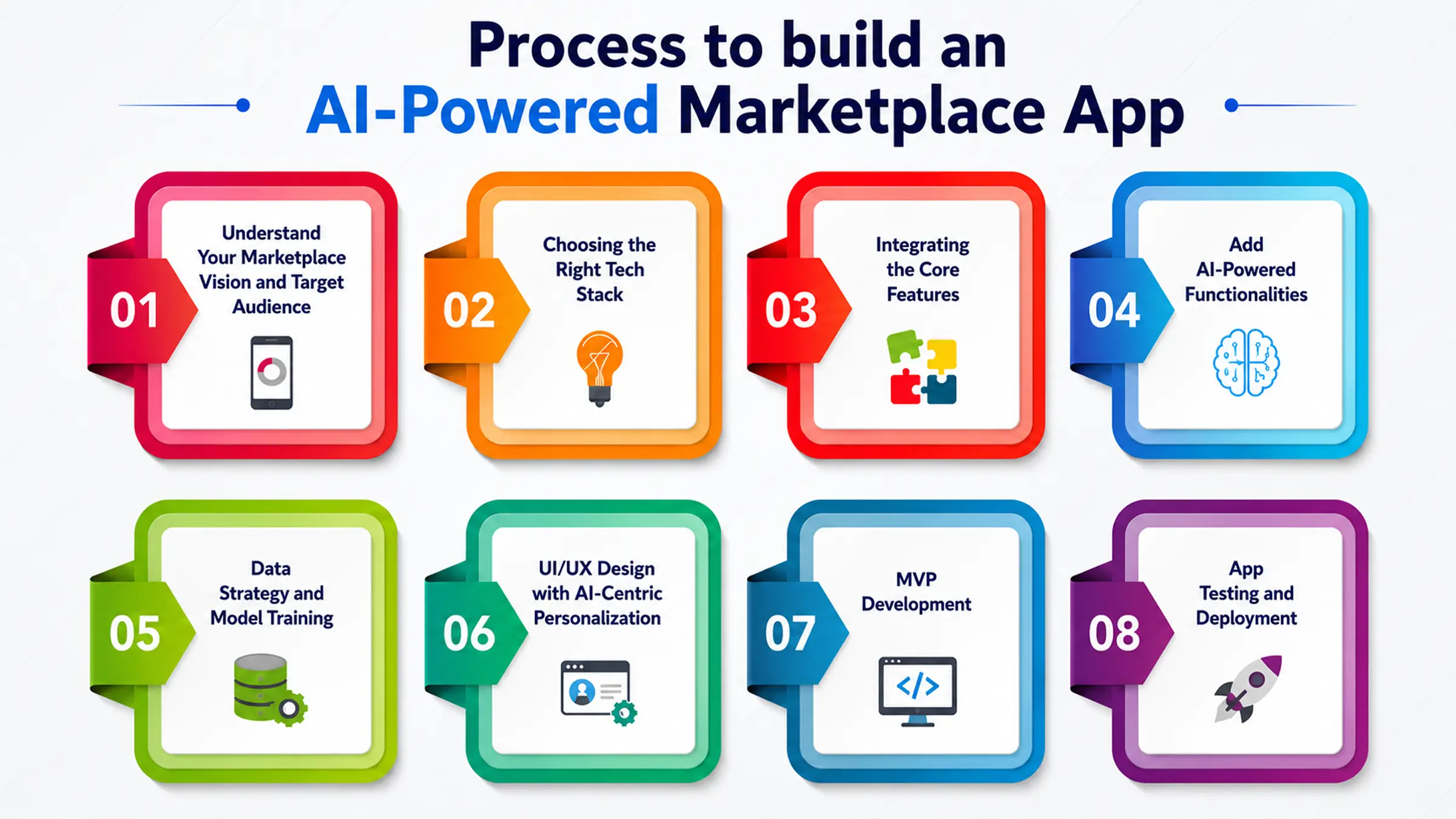
Must-Have Features of an AI-Powered Mobile App
A strong AI mobile app should include features that improve both user experience and business performance.
Key features may include:
- Personalized user dashboard
- AI chatbot or virtual assistant
- Smart search
- Predictive recommendations
- Voice-enabled interaction
- Secure login and authentication
- Push notifications
- Real-time analytics
- Admin dashboard
- Data privacy controls
- Feedback system
- In-app support
- Automated reports
The exact feature set depends on your industry and business goals. The best approach is to start with high-impact features and expand gradually.
How Much Does It Cost to Build an AI-Powered Mobile App?
The cost of building an AI-powered mobile app depends on app complexity, features, design, platform, AI model type, data requirements, integrations, and development location.
A basic AI mobile app with simple chatbot integration or recommendation features may cost less than a complex enterprise AI app with custom machine learning models, advanced analytics, and multiple integrations.
Estimated AI mobile app development cost:
- Basic AI app: $25,000 – $50,000
- Mid-level AI app: $50,000 – $120,000
- Advanced AI app: $120,000 – $250,000+
- Enterprise AI app: $250,000+
Major cost factors include:
- UI/UX design complexity
- iOS, Android, or cross-platform development
- AI model development or API integration
- Data collection and preparation
- Backend infrastructure
- Third-party integrations
- Security and compliance
- Testing and maintenance
- Post-launch support
Using third-party AI APIs can reduce initial development cost. However, custom AI models provide more control and business-specific value in the long run.
Also Read - Top Mobile App Development in Saudi Arabia: How Mobcoder Leads the Way
Popular Use Cases of AI-Powered Mobile Apps
AI can be used across many industries. Some common use cases include:
- E-commerce: product recommendations, smart search, customer support
- Healthcare: symptom checkers, health monitoring, appointment assistance
- Fintech: fraud detection, credit scoring, financial insights
- Education: personalized learning, AI tutors, progress tracking
- Real estate: property recommendations, virtual assistants
- Logistics: route optimization, delivery prediction
- Retail: demand forecasting, customer personalization
- Travel: smart itinerary planning, chatbot support
- Fitness: workout recommendations, health tracking
- Insurance: claim automation, risk analysis
These use cases show how AI can make mobile apps more intelligent and business-focused.
Future Trends in AI Mobile App Development
AI-powered mobile apps will continue to evolve rapidly. Some major trends include generative AI apps, AI agents, voice-first interfaces, on-device AI, hyper-personalization, predictive automation, and AI-powered cybersecurity.
On-device AI is especially important because it allows apps to process data faster and improve privacy by reducing dependency on cloud processing. Generative AI will also play a major role in content creation, customer support, product discovery, and workflow automation.
Businesses that adopt AI early and strategically will be better positioned to deliver smarter digital experiences.
Final Thoughts
Building an AI-powered mobile app is not just about adding advanced technology. It is about solving real business problems with intelligent digital experiences. The right AI app can improve customer engagement, automate operations, reduce costs, and create new growth opportunities.
To build a successful AI mobile app, start with a clear strategy, choose the right features, prepare quality data, use a scalable technology stack, and keep improving after launch.
If your business is planning to build an AI-powered mobile app, working with an experienced AI app development company like Mobcoder can help you reduce risks, speed up development, and create a solution that delivers measurable results. As a trusted AI development company in Riyadh, Mobcoder brings over a decade of experience and 300+ apps delivered across industries. Its team of AI/ML experts can help turn your idea into a scalable, intelligent product built for real business outcomes.
FAQs
What is AI mobile app development?
AI mobile app development is the process of building mobile applications that use artificial intelligence, machine learning, natural language processing, computer vision, or predictive analytics to deliver smarter features and personalized experiences.
How long does it take to build an AI-powered mobile app?
A basic AI app may take 3 to 5 months, while a complex enterprise-level AI app may take 6 to 12 months or more, depending on features, data, integrations, and AI model complexity.
What is the cost of AI app development?
The cost can range from $25,000 to $250,000+ depending on app complexity, AI features, platforms, technology stack, and custom model requirements.
Which industries can benefit from AI mobile apps?
Industries such as healthcare, fintech, ecommerce, education, logistics, real estate, travel, fitness, retail, and insurance can benefit from AI-powered mobile apps.
Should I use a custom AI model or a third-party AI API?
Third-party AI APIs are faster and more cost-effective for common use cases. Custom AI models are better for advanced, industry-specific, or data-heavy business requirements.