


While mobile apps are being used for everyday financial management like making transactions, banking, and paying bills, mobile app security becomes more important than ever. No room for error or security can be ignored, as cybercriminals are constantly targeting mobile applications.
Developers at leading mobile app development companies are doing everything on their part to make safe and secure apps. But as the threats evolve with time, security is something that will require ongoing efforts rather than one code practice.
Why do developers need to take mobile app security seriously?
As mobile devices become primary platforms for communication, the potential of attracting cyber threats also increases. The fact that cybercrime is predicted to cost the world $10.5 trillion USD in 2025, a single security miss can compromise millions of user accounts, expose confidential & financial information, and even discourage the app use.
Users want their data to be safe, without any fear of sensitive data breaches.
To keep the trust of the users and retain them on your apps, proactive mobile application security measures are essential. Developers need to safeguard user data, maintain brand integrity, comply with legal requirements, and ensure the long-term success of any mobile application.
Let’s look at some of the trends that every top mobile app development company needs to keep in mind while working on security.
Also Read - The Future of Cross-Platform Development: Flutter vs. React Native
Trends to follow in 2026 for Mobile Application Security
Looking towards 2026, several factors will define the future of mobile app maintenance and protection. Some of those practices will include;
Mobile API security
Poorly secured APIs are a major attack vector, allowing unauthorized access to sensitive data and system functionalities. In the coming years, app developers will emphasize more stringent API security protocols, including robust authentication and authorization mechanisms (e.g., OAuth 2.0, OpenID Connect), API gateway security, continuous vulnerability scanning, and behavioral analytics to detect anomalous API usage patterns.
The focus will be on securing every endpoint and ensuring data integrity during transit and at pause.
Advanced fraud safety measures
Mobile apps are prime targets for various forms of fraud, from account takeovers and payment fraud to synthetic identity fraud and malicious bot activity.
Future security strategies will move beyond traditional rule-based detection to incorporate advanced machine learning models that can identify complex fraud patterns in real-time.
This includes behavioral biometrics (analyzing how a user interacts with the app), device fingerprinting, transaction monitoring, and sophisticated anti-tampering techniques to prevent app manipulation and reverse engineering, thereby protecting both users and businesses from financial and data loss.
End to end security for data protection
The global end-to-end encrypted communication market is projected to grow from USD 7.41 billion in 2025 to USD 19.97 billion by 2032. In coming years, we will see more applications with End to End Encryption (E2EE) as part of their mobile application security checklist.
End to end security protects your messages or data on the sender’s device and at the receiver’s device just like you see on platforms like Whatsapp, Signal, Telegram and iMessages. No third party or even the service provider can access the data or files.
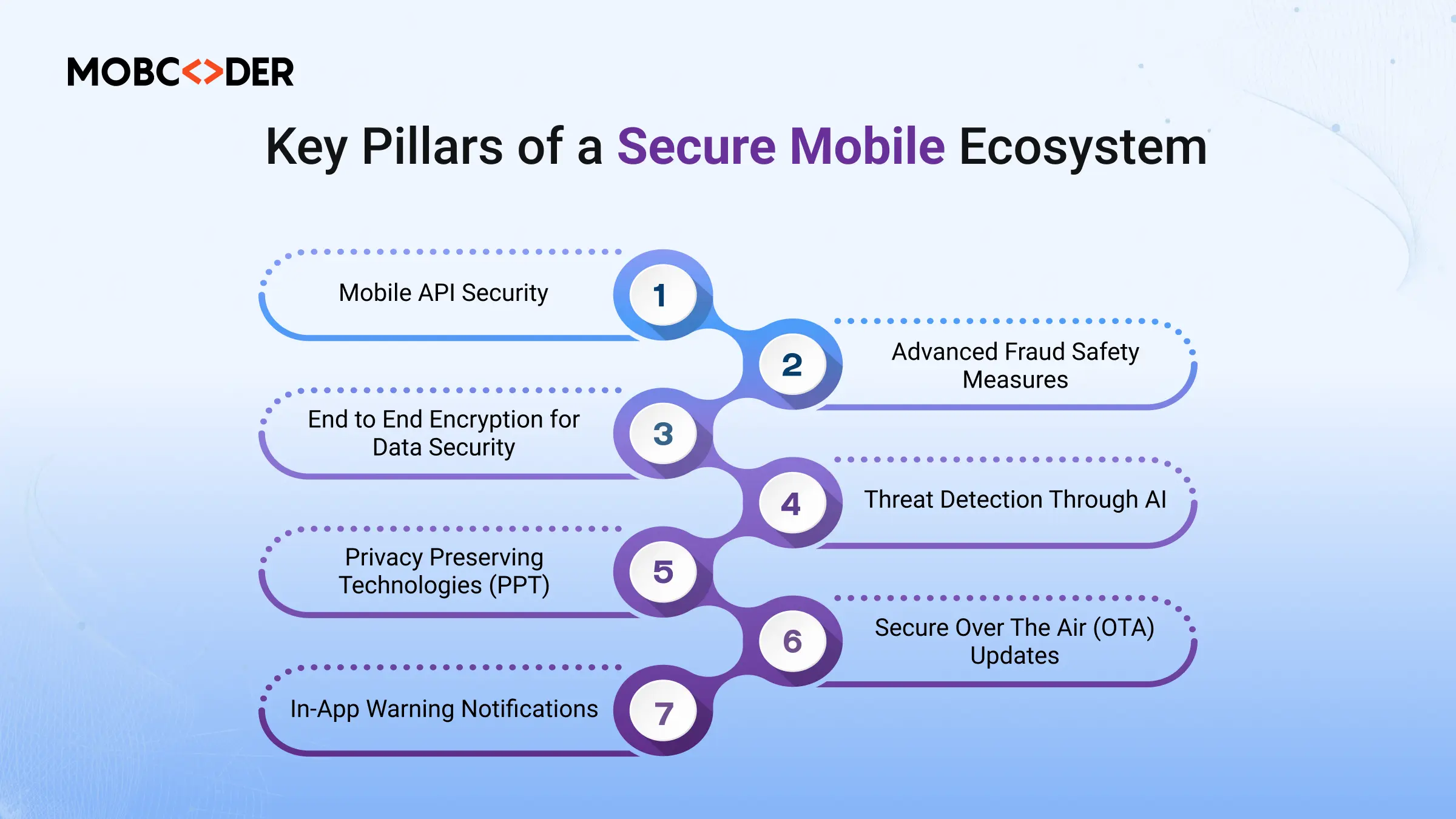
Threat detection through AI
Artificial intelligence and machine learning can help catch similar types of cyber attacks, which earlier used to be found manually. AI–forward tools can analyze large amounts of data sets and identify patterns of frauds.
AI can also detect natural language used in any phishing attack. By sensing the tone of the message, urgency to take a certain action or any sensitive data shared will be identified by AI.
Also Read - The Next Five Years of Custom Software: Trends to Watch Beyond 2025
Adapt privacy preserving technologies
In a future with growing concerns about data privacy, stricter regulations will make privacy-preserving technologies a must have. With the implementation of PPT, the apps will be able to maximize the usage of data for analytics and app functionality while purposely minimizing the exposure of sensitive user information.
Techniques such as differential privacy, adding noise to data to protect individual identities, training AI models on decentralized data without exposing raw data and secure aggregation will enable apps to return personalized experiences while protecting user anonymity and personal data judiciously.
Secure over the air (OTA) updates
To counter modern threats, OTA provides the infrastructure and right kind of flexibility. Features of OTA like real-time threat mitigation, dynamic API protection, and improved user experience makes it a top contender in mobile application security checklist for 2026.
By integrating runtime security solutions, developers can stay ahead of AI-powered bots and reverse-engineering attempts. Without the need to install new versions manually, OTA updates enable the deployment of these advanced defenses.
In-apps warning
Although technology-based protection is important, user empowerment via communication is also the need of the hour. Future mobile apps are expected to have smarter in-app notifications and educational hints.
Examples of these notifications include concerning possible security dangers such as using an unprotected Wi-Fi network or excessive permission requests, notifications concerning unusual activity in the account, or simply hints concerning good security behavior. The end-user can become an active participant in security by following a culture of caution within an application.
Responsibilities of Developers in the coming years
Mobile application security lies in the hands of developers. They have to deploy best mobile application security testing practice from the development process itself. Rather than relying on post-development review phases, they need to incorporate threat modeling, secure coding standards and vulnerability assessments during the design and development phase.
Since cyber threats evolve with time, ongoing monitoring and keeping up with the tech updates becomes an important aspect for mobile app development companies. They play a key role in safeguarding user data, maintaining trust and minimizing the risks posed by modern cyber threats.
Conclusion
With the increased reliance on mobile and rising cyber threats, developers and businesses must adopt preventive measures in order to keep an app secure. A well-defined mobile application security checklist can help identify vulnerabilities in the early stage of development and reduce risks significantly.
In the end, latest trends in mobile app security like combining secure coding practices, AI-driven threat detection, end to end encryption, and regular testing with reliable mobile app security services ensures stronger protection, greater user trust, and long-term app success.
As a business owner, if it is too much to keep up with the security trends, hiring our expert developers can take care of it. The developers at Mobcoder tackle mobile app security since day 1 of design and development.
Contact us for a detailed consultation on mobile app development services.
FAQs
What is mobile app security?
Mobile app security refers to protecting mobile applications from cyberthreats like data breaches, financial fraud, malware, and unauthorized access.
What are mobile app security testing tools?
These tools are specialized softwares that identify vulnerabilities in iOS/Android apps through static, dynamic, and penetration testing before and after app deployment.
What are mobile app security best practices?
Best practices include secure coding, data encryption, regular security testing, and timely updates to fix vulnerabilities.
What is the most common security threat to mobile apps?
Data leakage and phishing is the most common threat, often caused by weak encryption or insecure data storage.
Where to find mobile app security services?
You can find reliable mobile app security services at Mobcoder, offering end-to-end app development and protection measures.


