



The business intelligence market has witnessed a paradigm shift since the time we stepped into the year 2026. With more than 28,000 businesses worldwide using Microsoft Fabric and Power BI embedded as a core workload, the enterprise data landscape has transformed from traditional reporting to AI-driven analytics ecosystems.
With Power BI advancing with enhanced AI capabilities, the PBIR format now in general availability within this year and Copilot at the forefront of analytics, growing businesses are now faced with a crucial decision: to handle this complexity on their own or to collaborate with a professional Power BI development company, who can offer unique insights to help them transform at a faster pace.
The last decision definitely depends on the business, but what makes working with a Power BI dashboard development company unique is something that you should pay attention to.
Power BI Has Evolved Beyond Basic Reporting in 2026
Power BI now looks very different from what it used to, even like two years ago. In recent years, the platform has changed from a standalone BI tool to a full analytics workload in Microsoft Fabric. This gives it enterprise-level capabilities that completely change how it needs to be set up.
The current environment has the use of AI-driven Copilot, which is capable of converting natural language to DAX queries, Azure Maps, and PBIR format that enables Git integration and DevOps. These are new ways of building buildings that require specific knowledge to be done well.
The integration with OneLake in Fabric enables the creation of data foundations, but to achieve this, one requires a lot of knowledge in data engineering, lakehouse architecture, and governance models, which is not common in most internal teams. Most companies that attempt to do this on their own soon realize that the implementation of semantic models, performance scaling, and ensuring that security is optimal takes years of expertise.
Companies that specialize in Power BI development services have already experienced these changes, implemented new ways of working that are optimized by Copilot, and developed solutions that interact with Fabric. They come along with best practices that help companies avoid costly pitfalls.
Also read: How Professional Flutter Developers Structure Their Apps
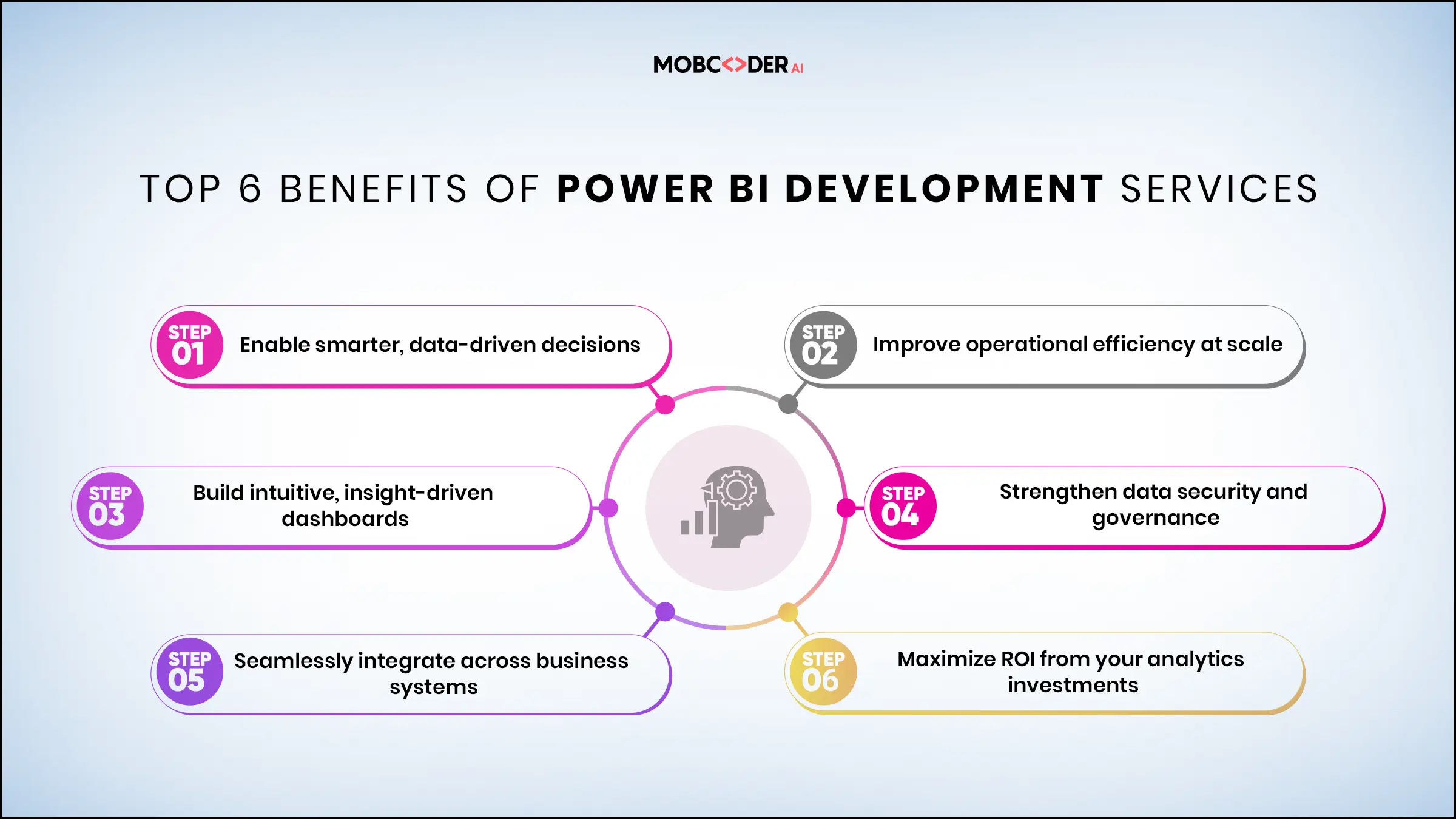
The Real Cost of DIY Power BI Implementation
As Power BI becomes more sophisticated, the risks of DIY implementation multiply. Organizations attempting to navigate the process without expert guidance face predictable and expensive challenges like:
- Extended Migration Timelines: The move to the PBIR format is a paradigm shift in the way that reports are stored and handled. Without proper expertise, this migration process can come to a grinding halt for months as teams wrestle with Git integration, continuous deployment pipelines and version control approaches. What should be a smooth transition becomes a project-blocking issue.
- Mistakes in AI Integration: Copilot for Power BI now has capabilities in the realms of DAX query writing, visual development based on natural language inputs and AI recommendations. However, doing this right, with the right validation workflow, governance, and best practices in prompt engineering, is a level of sophistication that few in-house teams have. The consequence? AI capabilities that remain unused or, worse, deliver subpar outcomes that erode user trust.
- Performance Degradation at Scale: With millions of transactions per day in the Microsoft Fabric lakehouse architecture, a bad data model design causes catastrophic bottlenecks. Dashboards that take too long to load are a source of user frustration, lead to low adoption, and require costly rewrites. Experienced developers know the partitioning strategies, aggregation tiers, and incremental refresh settings that can avoid these problems before they happen.
- Governance and Security Gaps: As the size of Power BI environments and the number of business groups publishing content independently grow, governance challenges become more intricate. Organizations struggle to track dynamic datasets, identify possibly harmful reports, and maintain data quality without proper governance frameworks in place. The requirement for metadata-driven discovery and quality monitoring in 2026 demands a sophisticated level of governance that must be set by experts from scratch.
- Integration Complexity: Modern implementations in Power BI development services are no longer self-contained solutions. They are coupled with Azure services, Teams and SharePoint for collaboration, and enterprise data warehouses. Coupling these solutions for performance, security, and robustness is a capability that crosses multiple platforms, and generalists do not possess this knowledge.
The hidden costs, lost productivity, delayed insights, technical debt, security vulnerabilities, and failed AI initiatives—typically exceed professional development services by 3-5x. Organizations that invested in dedicated expertise report ROI on every dollar spent on Fabric implementations, proving the financial impact of doing it right from the start.
Also read: Profitable Custom App Development for Startups: A Complete Guide
Why Specialized Power BI Development Services Matter
Power BI innovation pace has accelerated dramatically. January 2026 features introduced enhanced Copilot with report attachment, Azure Maps migration, modern visual tooltips, and upcoming PBIR default transition. Staying current requires dedicated focus internal teams can't sustain alongside day-to-day responsibilities.
Dedicated companies invest continuously in training and hands-on experience with emerging capabilities:
- Advanced AI Integration: Implementing AI-assisted modeling, automated DAX generation with validation frameworks and intelligent recommendations enhancing productivity with proper governance controls
- Microsoft Fabric Architecture: With organizations adopting Fabric, specialists architect OneLake foundations, implement Fabric IQ for automated quality monitoring, and design lakehouse structures handling massive scale
- Real-Time Intelligence: Configuring streaming datasets, implementing Real-Time Intelligence workloads, and designing continuously updating dashboards requiring deep event processing expertise
- Enterprise DevOps: Implementing version control strategies, automated testing, and deployment orchestration leveraging PBIR's Git integration capabilities
- Cross-Platform Integration: Architecting seamless connections across Azure, AWS, Google Cloud, and hybrid environments with shortcuts for accessing data without movement
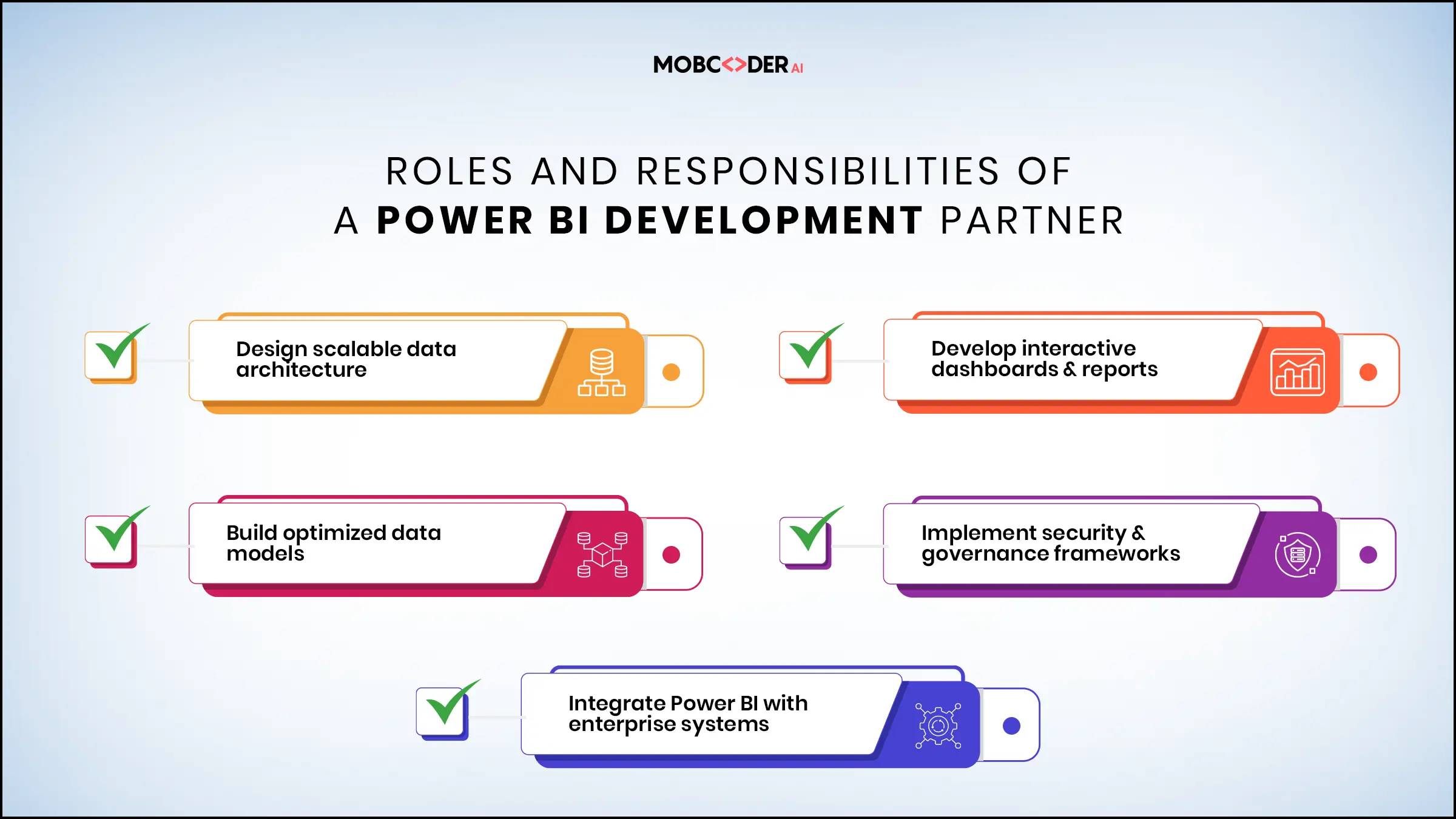
Also read: Mobile App Security in 2026: Key Trends to Look Out For
Faster Time-to-Insight Drives Measurable ROI
Speed matters critically in 2026's competitive environment. While internal teams navigate learning curves with new PBIR formats, Copilot workflows, and Fabric integrations, dedicated Power BI developers deliver immediately with proven frameworks and tested architectures.
Professional development companies bring ready-made templates, reusable components, and established patterns that dramatically reduce implementation time. They know which approaches work for specific industries and use cases, eliminating trial-and-error experimentation that costs weeks or months. This efficiency translates directly to ROI.
Enterprise-Grade Solutions Built for Scale
Growing enterprises need solutions architectured for future demands, not just current needs. Dedicated Power BI development companies design with enterprise requirements embedded from the foundation:
- Robust Data Governance: Implementing comprehensive frameworks leveraging metadata-driven discovery, automated quality monitoring through Fabric IQ, and security controls that scale across expanding data estates
- Scalable Architecture: Designing lakehouse structures, semantic models, and OneLake foundations that handle exponential data growth and user populations without performance degradation
- Change Management: Providing structured adoption programs ensuring teams effectively leverage AI capabilities, self-service frameworks, and collaborative features
- Continuous Evolution: Offering ongoing optimization, feature adoption, and enhancement as both business needs and platform capabilities advance
These aren't afterthoughts—they're architectural principles that prevent the technical debt plaguing DIY implementations.
Cross-Industry Intelligence Accelerates Success
Specialized development companies apply their expertise in the healthcare, finance, retail, manufacturing, and logistics sectors. They bring learnings from various implementations to each new project. They understand which Copilot questions lead to the greatest productivity, which semantic model designs are most effective for a given task, and which governance strategies are most effective for a given business. This is not possible in-house.
When a financial services company requires real-time risk analysis dashboards, experts learn from manufacturing. When a retail company requires customer segmentation, developers apply knowledge from healthcare analytics.
Conclusion
The decision to work with a dedicated Power BI development company in 2026 isn't simply about outsourcing a technical task. It's a strategic choice to accelerate digital transformation, maximize return on analytics investments, and build sustainable competitive advantages in an environment where AI-powered insights determine market winners.
Growing enterprises recognize that data is too critical to leave to chance. While Power BI and Microsoft Fabric provide extraordinarily powerful capabilities, extracting their full value requires specialized expertise, proven implementation methodologies, and continuous optimization as the platform evolves.
Getting professional Power BI Consulting and Development Services can bridge this gap comprehensively. They deliver all three essential elements—deep technical expertise, battle-tested frameworks and forward-looking optimization, transforming data from a liability into an asset that drives measurable business outcomes.
FAQs
1. When should a business hire Power BI development services?
When migrating to Microsoft Fabric, adopting Copilot, implementing PBIR with Git, or scaling dashboards enterprise-wide. If performance, governance, or architecture feels complex, it’s time for specialists.
2. How are professional Power BI development services different from in-house efforts?
In-house teams often focus on reports. Dedicated Power BI development companies deliver full architecture, data modeling, governance, DevOps, AI integration and scalability.
3. Do Power BI development services improve ROI?
Yes. Faster deployment, optimized performance, reduced rework and higher adoption directly translate into measurable business returns.
4. Can a Power BI development company help with Microsoft Fabric integration?
Absolutely. Experts design OneLake foundations, lakehouse structures, semantic models and ensure seamless Fabric + Azure integration.
5. Is DIY Power BI implementation risky in 2026?
With PBIR, Copilot, and Fabric complexity, DIY often leads to delays, technical debt and security gaps. Expert-led implementation reduces these risks significantly.


