

Mobcoder has delivered over 300 apps across various industries. When a business owner comes to us with a product idea, we understand the importance of delivering a business value proposition that drives growth.
Because app development for startups isn’t just about building features or brand presence, it’s about building business growth and ROI.
We have created this guide to help new founders, CTOs, and business owners understand the basics of custom app development and identify key factors to consider before getting app development services.
Also Read - Super Apps in 2026: How Brands Can Build All-in-One Digital Ecosystems
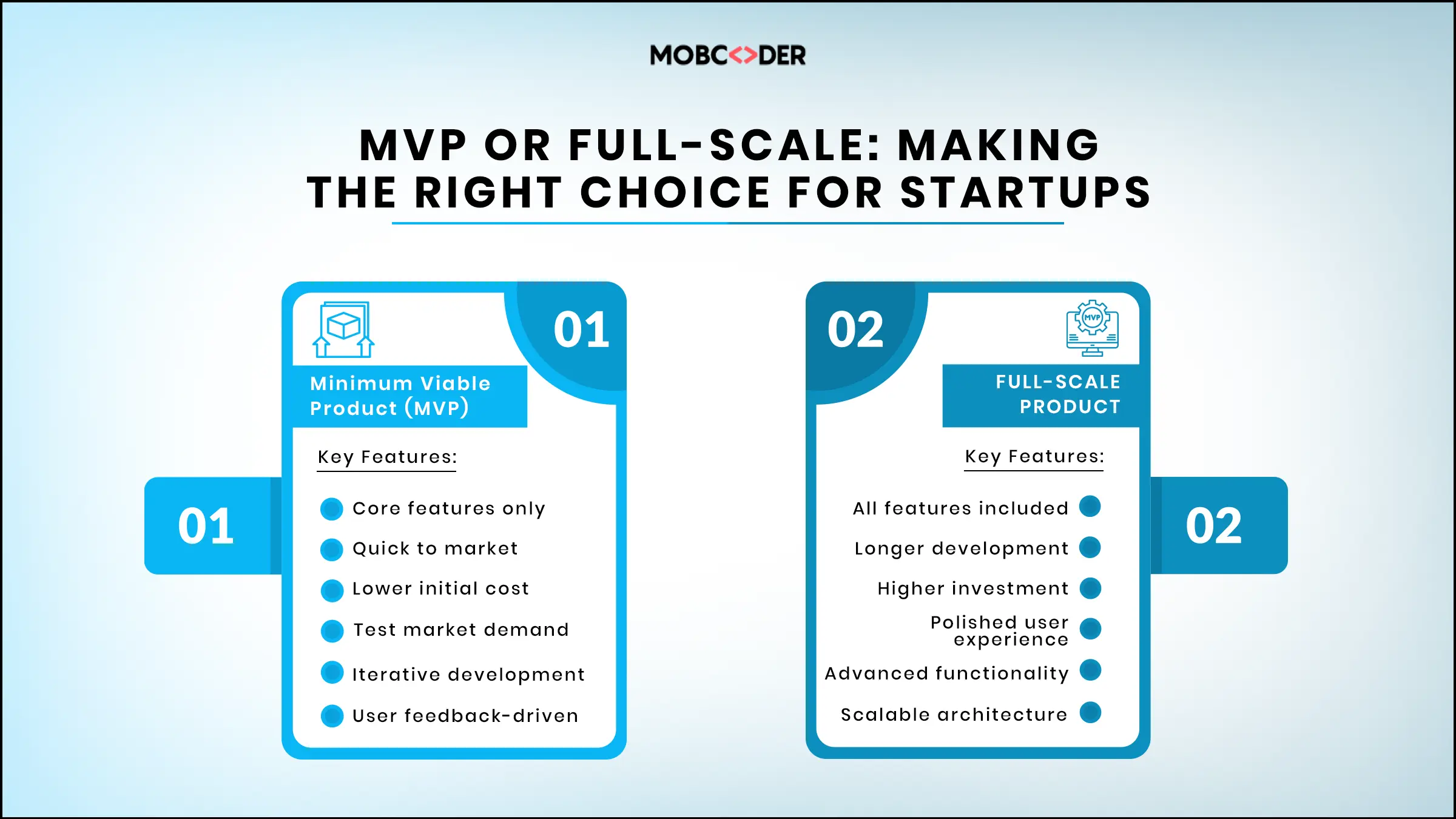
MVP vs Full-Scale: Making the Right Choice for Startups
Every startup faces this decision. Here's how to choose:
Build an MVP First If:
- You’re pre-seed or bootstrapped with little runway
- Your market validation is (still) speculation.
- You need the investor's proof-of-concept quickly
- You can have 3-5 key features that actually prove your core value prop.
Example: A meal planning app would want to prove that its users have an appetite for AI-generated recipes before investing in social, grocery and dietary features.
Go Full-Scale If:
- You're A+ funded and can afford full development
- You're joining a competitive marketplace where polish is what sets you apart
- Your business model is not viable (marketplaces need critical mass)
- Good feature completeness from day one is a must for regulatory compliance
Example: A healthcare portal for hospitals cannot go live with MVP – they have compliance, security, and integration considerations that require production software.
The Smart Hybrid Approach: Build MVP scope with full-scale foundations. This means core features only, but built on scalable infrastructure with clean, documented code that's easy to expand.
- Cost impact: 20-30% more than bare-bones MVP
- Savings: 60-80% less than a full rebuild when you scale
What drives the costs of building an app?
The cost of developing mobile apps in 2026 depends on several factors, a few of which are:
- Number of types of users (customer, admin, vendor)
- Third-party Integration
- Live features: real-time chatting, tracking, notifications
- Compliance obligations (HIPAA, GDPR, PCI-D)
- Platform choices (iOS only, iOS and Android, or web)
Also Read - Digital Transformation Best Practices For U.S Enterprises
How App Development Decisions Drive ROI
Smarter startups are not just creating applications; instead, they are making strategic investments that multiply over a certain period of time. In this way, app developers for startups help create custom apps that turn code into capital.
Cost-to-Value Ratio in MVP
An MVP is 60-70% less costly than building a full app, taking fractions of the time to develop as well. More importantly, you will gain real data from actual users before investing heavily. You won’t be guessing what people want.
Scalable Architecture in Custom App
Scalable infrastructure will be 15-20% more expensive upfront, but will yield multiple times that savings as you scale from 1,000 users all the way up to 100,000 without having to rebuild.
Performance, UX & Security: Directly Affecting the Bottom Line
Numbers don’t lie.
- Increasing load time by even one second can lower conversions by 7%
- A bad user experience can increase your churn rate by as much as double before customers begin to understand the value proposition
- User experience design enhances conversion by 200% or even higher
- One incident of a security breach can shatter months of trust-building. These aren’t optional polish, these are the basics of retention, conversion, and sustained growth
Once your MVP is out, now comes the data. You can see usage patterns, feature requests, and revenue metrics. This means that you now know exactly where the next dollar needs to go.
Rather than developing five things you think consumers will like, you develop the two features that actual data has demonstrated will generate revenue. Each iteration cycle is now based on investment, not conjecture.
Development Is Investment, Not Expense
By building MVP first, you validate before you scale. By selecting a scalable architecture, you select sustainable growth. By optimizing for performance and User Experience, you optimize for retention and revenue.
It's not a question of whether you can afford to build in a strategic manner. It is a question of whether you can afford to fail to do so.
Also Read - AI in Construction: How to Use it for Site Safety Monitoring
5 Questions to Ask Before Hiring App Developers for Startups
1. "Show me projects where the scope changed mid-development. How did you handle it?"
Startups always pivot. You need flexible partners, not ones who charge for every small change.
2. "How do you prioritize features when we have 20 ideas and a budget for 5?"
Great developers help you make smart business decisions, not just take orders.
3. "What would you build differently if this were your startup?"
You want partners who think like founders and offer strategic guidance.
4. "What typically needs optimization in the first 90 days after launch?"
Realistic expectations prevent nasty surprises and budget overruns.
5. "What would you NOT recommend for our use case and why?"
Honest partners tell you what works and what won't, not just what they're good at.
Red Flags to Watch:
- They think they understand everything (no dissent = no expertise)
- Timeline appears to offer far too good to be true
- Difficulty in Explaining Technical Choices in Simple English
- No questions about the business model or audience of your brand. Portfolio includes only designs, not functional items
Before You Start: Founder's Checklist
When you evaluate app development companies for your business, it is important to be prepared for the questions the other party may want to ask. Follow the checklist to get started:
Business Clarity:
- ☐ I can describe my value proposition in a sentence
- ☐ I know who my first 100 customers will be
- ☐ I have defined success metrics other than vanity metrics
- ☐ I measure product-related activities
- ☐ My budget includes post-launch costs
Technical Readiness:
- ☐ I’ve differentiated must-haves from nice-to-haves
- ☐ I know which platform my users are on
- ☐ I’ve researched industry requirements for compliance
Partnership Readiness:
- ☐ I have realistic timelines in mind (min 8-12 weeks)
- ☐ I understand that change takes time and money
- ☐ I can commit to weekly check-ins
If you can't fulfill most of the boxes, then you're not ready to build an app yet, and this is perfectly fine. This will save you tens of thousands of dollars in the long run.
Also Read - AI Agents in Banking: Streamline Back Office Operations and Customer Interaction
What Happens After App Launch
After the whole discussion and checklist, when you get onboard, the following timeline is expected:
Week 1-2: Immediate Response
Something will break. Monitor crash reports, create analytics, and have developers at the ready for quick fixes.
Data Collection: Week 3-8
Don't add features yet. Watch activation rates, retention metrics, feature usage, and drop-off points. Talk to at least 10 users directly.
Week 9-12: First Iteration
Now make data-driven decisions: fix major usability issues, improve onboarding, and add the one most-requested feature from engaged users.
The Actual Timeline:
- Months 1-3: Learn, fix, optimize
- Months 4-6: Add strategic features based on data
- Months 7-12: Scale what works; kill what doesn't
Note: This is just a generic timeline; it may vary as per the industry, app requirements, and expertise of app developers for startups.
The Bottom Line
You now have the framework to make informed development decisions: when to build MVP vs full-scale, what drives costs, how to evaluate partners, and what to expect post-launch.
The next step? Use the founder's checklist to assess your readiness. If you can check most boxes, you're ready to build. If not, take the time to clarify your strategy first with app developers for startups.
App development for startups isn't done perfectly from day one. It requires strategic decisions that compound over time. Start smart, iterate based on data, and scale what works.
Ready to take your business to the app? Talk to us.
FAQs
1. What is app development for startups?
App development for startups focuses on building scalable, ROI-driven applications that validate market demand, support rapid iteration, and enable long-term growth.
2. Should startups build an MVP or a full-scale app first?
Most startups should build an MVP first to test market demand, reduce risk, and gather real user data before investing in full-scale development.
3. What is custom app development for startups?
Custom app development involves building an application tailored to a startup’s business model, users, and growth goals rather than using pre-built or generic solutions.
4. How much does app development for startups cost?
Costs depend on features, platforms, integrations, and compliance needs. MVPs are typically 60–70% cheaper than full-scale apps.
5. How long does it take to develop an app for a startup?
An MVP usually takes 8–12 weeks, while full-scale apps take longer depending on complexity and regulatory requirements.
6. Why is scalable architecture important in startup app development?
Scalable architecture prevents expensive rebuilds and allows startups to grow users and features without disrupting performance or stability.
7. How do app developers for startups improve ROI?
Experienced app developers prioritise high-impact features, optimise performance and UX, and align development decisions with measurable business outcomes.
8. What should startups look for when hiring app developers?
Startups should choose developers who understand pivots, prioritise features strategically, communicate clearly, and focus on business value, not just code.